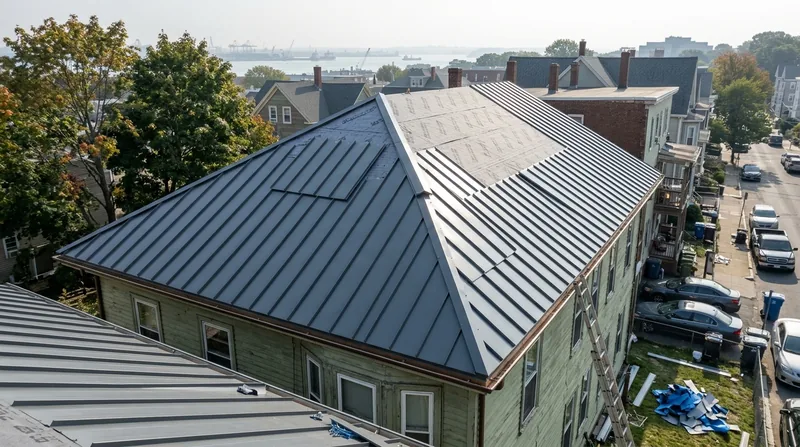




Metal roof installation in Boston is a different animal from the same job in a suburb with wide lots and easy roof access. This city sits on a glacial-till peninsula at the edge of Boston Harbor, with granite ledge under the soil, tight lots, and 1850s-1900s brick row houses in Beacon Hill, the Back Bay, and the South End whose flat and low-slope roofs leave no room for error on flashing. Triple-deckers in Dorchester, Somerville, Chelsea, and Revere have shallow-pitch roofs that punish cheap underlayment, and the Victorian and Queen Anne houses in Jamaica Plain and Cambridge throw steep gables, dormers, and towers that demand custom panel work. Salt air off the harbor eats fasteners, winter piles snow and forms ice dams, and nor'easters drive rain sideways into seams. We install panel systems built for that exact combination: high-temperature synthetic underlayment, ice-and-water membrane at the eaves, proper attic ventilation, and manufacturer-approved flashing details. If you are comparing systems, start with our standing seam metal roofing page before you decide on a profile.
Why Metal Roof Installation in Boston Is a Different Job Than Anywhere Else
Boston's building stock and its weather put specific stress on a roof. The dense mix of low-slope triple-deckers, brick row houses with parapet walls, and steep-gabled Victorians means the same crew can face a membrane detail in the morning and a tower panel in the afternoon. Add salt air, heavy snow loads, daily freeze-thaw, and nor'easters that push rain sideways, and the failure mode that dominates here is water driven under seams and around flashing, not simple wear. That is why the details matter more than the panel gauge on most Boston roofs.
- Ice-and-water membrane at the eaves stops ice dams on shallow-pitch triple-decker roofs in Dorchester and East Boston.
- High-temperature synthetic underlayment resists condensation and heat cycling on low-slope city roofs.
- Correct attic ventilation prevents warm air from melting snow and refreezing at the gutters in Newton and Quincy.
- Manufacturer-approved flashing details handle chimney stacks and bay windows on Beacon Hill row houses.
- Corrosion-rated fasteners and trim stand up to harbor salt air in Charlestown and the Seaport edge.
Each of these items is a line item on the estimate, not an upgrade you discover after the first nor'easter. Before any work starts, confirm the permit rules with the City of Boston Inspectional Services Department at boston.gov, because thresholds and inspection requirements vary by neighborhood and historic district.
Key info: On a bowfront townhouse in the Back Bay, the bay window roof is a separate small roof with its own flashing tie-in. If the installer treats it as an afterthought, that is where the leak shows up first, usually above the second-floor window trim.
How We Install a Metal Roof on a Boston House, Step by Step
Every installation starts with a tear-off and deck inspection, because you cannot know what the sheathing looks like until the old roof is off. On 1890s wood-frame triple-deckers, we routinely find soft decking around chimneys and skylights that has to be replaced before any metal goes down. We then work from the eaves up, setting underlayment, membrane, panels, and flashing in an order that keeps the roof watertight at the end of every day. The sequence below is the same on a Cape in Milton and on a brick row house in the South End.
- We tear off the existing roof and inspect the deck for rot, soft spots, and failed sheathing.
- We install ice-and-water membrane at the eaves and in valleys, then high-temperature synthetic underlayment across the field.
- We set the panel layout so seams land on purlins and panel lengths avoid unnecessary laps.
- We fasten panels with corrosion-rated screws and clips, then install ridge, hip, and rake trim.
- We flash chimneys, skylights, bay windows, and sidewalls with manufacturer-approved details.
- We check attic ventilation and confirm intake and exhaust are balanced before we close up.
- We walk the roof and the ground, clean fasteners and metal shavings, and do a water test on the flashing.
The order matters because a roof that is watertight at the end of each day protects the interior if a thunderstorm rolls through overnight. For homes where the existing shingles are sound and code allows a recover, we also handle metal roof over shingles as a separate scope.
Key info: On a steep Queen Anne gable in Jamaica Plain, the tower and dormer panels are measured and bent off-site, then carried up by hand. A crew that tries to form those pieces on the roof will leave open laps and a flashing detail that fails within two winters.
Installation Approaches We Use Across Boston Roofs
The right approach depends on pitch, building type, and how visible the roof is from the street. A low-slope triple-decker in Somerville and a steep Colonial in Lexington do not get the same system, and a historic district may restrict the profile and color you can use. The table below maps the main approaches to the Boston housing types where they fit best.
| Approach | Description | Best for |
|---|---|---|
| Standing seam | Concealed fasteners, raised seams, long panel runs with minimal penetrations | Low-slope triple-deckers, dormers, and additions where leaks are the main risk |
| Exposed-fastener panels | Corrugated or ribbed panels screwed through the face, fast to install and easy to repair | Barns, sheds, and workshops on larger lots in the outer suburbs |
| Metal shingles | Stamped shingle profiles that mimic slate or shake with interlocking panels | Capes and Colonials in Quincy, Newton, and Needham where the look matters |
| Stone-coated steel | Steel panels coated with stone granules in slate and shake profiles | Victorian and Second Empire roofs that need a traditional street look |
| Copper and specialty metal | Soldered or mechanically seamed copper for small, visible roof areas | Bay windows, cupolas, and porch roofs on Back Bay and Beacon Hill homes |
We match the panel system to the pitch, the historic review rules, and how the roof sheds snow before we quote a number.
Metal Roof Installation Cost in Boston: What to Expect
Pricing for a full metal roof installation in Boston starts around $8 per square foot for a basic exposed-fastener panel over a simple roof, and climbs from there. The variables that move the number most are roof pitch and access, the number of chimneys, dormers, and bay windows that need flashing, whether the deck needs repair after tear-off, and whether the job sits in a historic district that limits panel profile and color. A steep, cut-up Victorian roof in Jamaica Plain costs more per square foot than a clean low-slope run on a triple-decker in Chelsea, and that is true for any honest contractor.
Getting two or three written estimates is the smartest move you can make. It gives you a real range for your specific roof, it exposes contractors who quote low and then add deck repair and flashing as extras, and it lets you compare panel systems and warranties side by side. Ask each bidder to itemize underlayment, membrane, flashing, ventilation, and disposal so the numbers are comparable. Our full metal roofing pricing overview breaks down the line items you should expect to see.
Metal Roof Installation Near Me: How to Vet a Contractor in the Boston Area
When you search for metal roof installation near me, the results all look similar, so the vetting has to happen on paper and on the phone. Then ask for local references on the same building type as yours, because a contractor who is strong on new construction may never have flashed a Beacon Hill bay window. Finally, confirm who pulls the permit and how the company handles historic district or HOA design review, since those approvals can delay a start date by weeks.
- Request two or three references from Boston-area jobs on the same roof type and pitch.
- Confirm in writing who pulls the roofing permit and who schedules the inspection.
- Ask how the company handles historic district and HOA design review for panel profile and color.
- Get the disposal, deck repair, and flashing scope itemized in the written estimate.
If a contractor hesitates on any of these, keep looking. You can reach us through our contact and free estimate page when you are ready to compare a written scope against the others.
Snow, Ice, and Salt: Why Boston Roofs Need the Right Details
Boston's winter is the real test of an installation. Heavy snow loads sit on low-slope roofs, ice dams form at the eaves when warm attic air melts snow that refreezes at the cold edge, and daily freeze-thaw works on every seam and fastener. Salt air off the harbor corrodes cheap fasteners and thin flashing, and nor'easters drive rain sideways into any gap the installer left. The details that survive here are the ones we build into every job: membrane at the eaves, balanced ventilation, corrosion-rated fasteners, and flashing that is mechanically fixed, not just caulked. If your roof already shows the signs, our metal roof inspection service can tell you whether a repair or a replacement is the right call.
We install roofs to a 40 to 60 year service life when the details are done right. That means the difference between a roof that lasts and one that leaks in year eight usually comes down to the flashing and the fasteners, not the panel.
Metal Roof Installation in Boston: Pricing Guide
| Service | Price | Details |
|---|---|---|
| Exposed-fastener panel installation | Starting at $8/sq ft | Includes tear-off, synthetic underlayment, panels, and basic trim on a simple roof with straightforward access. |
| Standing seam installation | Starting at $14/sq ft | Concealed fasteners and raised seams; price rises with roof pitch, panel length, and the number of penetrations. |
| Stone-coated steel or metal shingle installation | Starting at $12/sq ft | Includes profile panels and trim; steeper roofs and complex gables add labor and custom bending. |
| Copper and specialty metal | On estimate | Small bay window, cupola, and porch roofs need an on-site look before a number is given. |
| Travel | Included | In Boston and surrounding areas, no separate call-out or mileage fee. |
| Estimate | Free | Response within 24h at (857) 465-5405, no obligation to book. |
Indicative pricing, the exact cost depends on square footage, finish, and site access. Free personalized estimate within 24h at (857) 465-5405.


