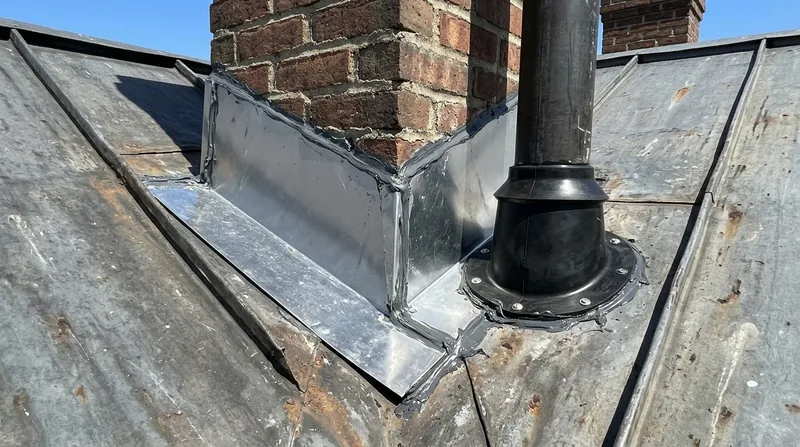




Metal roof leak repair in Boston starts with finding the actual entry point, not the ceiling stain. This city sits on a glacial-till peninsula at the edge of Boston Harbor, and the housing stock above it tells the story: 1850s brick row houses and bowfront townhouses on Beacon Hill and the Back Bay, wood-frame triple-deckers across Dorchester, South Boston and East Boston, and steep-gabled Victorians in Jamaica Plain and Cambridge. Salt air off the harbor eats fasteners, nor'easters drive rain sideways into seams, and winter freeze-thaw pushes ice under flashing. We trace leaks to failed screws, separated seams, pipe boots, chimney gaps and ice-dam backups, then fix the cause. Call (857) 465-5405 for priority response. If the leak sits in a section of roof beyond a simple repair, see our metal roof repair service for the broader scope.
Why Metal Roofs Leak Differently in Boston's Climate
Boston's leak pattern is not a southern rain problem. It is a snow-load, ice-dam and salt-corrosion problem layered onto dense, tight-lot housing. On a low-slope standing seam roof over a Somerville triple-decker, the failure is usually a seam that lifted or a fastener that backed out after a winter of expansion. On a Back Bay bowfront, it is copper flashing at the bay window that has thinned and pinholed. On a steep-gabled Victorian in Roslindale, it is often a pipe boot or a chimney counterflashing gap that only shows during a sideways nor'easter.
- Failed fasteners back out as the panels expand and contract through freeze-thaw cycles, opening a path for water.
- Seam separation on standing seam panels lets wind-driven rain push under the panel on exposed low-slope roofs.
- Ice-dam backups force meltwater under the eave and behind flashing when snow sits on a shallow pitch.
- Corroded flashing at chimneys and bay windows fails faster near the harbor where salt air accelerates oxidation.
- Pipe boots and vent collars crack at the rubber seal after a dozen Boston winters and leak quietly for months.
Each of these has a specific fix, and caulking over any of them buys you one season at best.
Key info: After the March nor'easters, we routinely find leaks on Charlestown and East Boston roofs where wind peeled back a ridge cap or lifted a panel edge. The water shows up two rooms away from the actual gap, which is why we trace from the attic and the deck, not from the stain.
For official guidance on roofing permits and inspection thresholds, check the City of Boston Inspectional Services Department at boston.gov; rules vary by neighborhood and historic district.
How We Trace and Fix a Metal Roof Leak in Boston
We do not start with a caulk gun. We start with water testing and a deck-level inspection, because on Boston's older homes the visible drip is rarely where the roof is open. A leak above a South End bay window can originate at a chimney two bays over. We map the roof, check every penetration, and only then quote the repair.
- We inspect the roof deck, seams, fasteners and all flashing from the attic side and the exterior.
- We run controlled water tests to isolate the entry point instead of guessing from the interior stain.
- We identify the failure mode: backed-out screw, open seam, failed boot, corroded flashing or ice-dam damage.
- We replace the failed component with matching metal and proper sealant, not a surface patch.
- We re-check the repair under water and document it with photos for your records or insurance file.
If the leak traces to a fastener pattern across the whole roof plane, we move to full re-fastening rather than chasing individual screws.
Key info: On a Dorchester three-decker with a low-slope standing seam roof, a homeowner had paid twice for caulk around a vent pipe. The real leak was a separated seam eight feet uphill. We closed the seam properly and the ceiling stayed dry through the next thaw. When fasteners are the pattern, see our screw replacement and re-fastening service.
Repair Approaches We Use on Boston Metal Roofs
Not every leak calls for the same method. The right approach depends on the panel type, the pitch and how much of the roof is compromised. Here is how we match the fix to the failure.
| Approach | Description | Best for |
|---|---|---|
| Targeted component repair | We replace the failed boot, vent collar or single fastener with matching parts. | Isolated leaks at one penetration |
| Seam and panel repair | We re-crimp, re-seal or replace a lifted standing seam panel section. | Low-slope standing seam roofs on triple-deckers |
| Flashing rebuild | We cut out corroded chimney, skylight or bay window flashing and rebuild it in metal. | Salt-corroded copper and step flashing |
| Full re-fastening | We replace backed-out screws across the panel field with oversized neoprene washers. | Exposed-fastener panels with widespread leaks |
| Ice-dam and eave repair | We correct the eave detail and address the backup path under the panel. | Shallow-pitch roofs that leak every thaw |
We recommend the least invasive method that actually stops the water, and we tell you when a repair will not hold.
Metal Roof Leak Repair Cost in Boston: What to Expect
Metal roof leak repair in Boston starts at $450 for a straightforward visit: trace the leak, replace a failed boot or a handful of fasteners, and water-test the fix. That starting figure covers diagnostic time and a simple component repair. Most jobs land above it once access and scope come into play. A steep Victorian gable in Jamaica Plain, a tight Back Bay alley with no ladder placement, or a leak that turns out to be corroded chimney flashing all add labor and material.
Factors that move the number: roof height and pitch, whether we need staging on a narrow Charlestown lot, how much flashing must be rebuilt, whether the panel field needs full re-fastening, and how hard the leak is to isolate. A single repair on an accessible Newton Cape is a different job from a multi-point leak on a Revere low-slope roof after an ice dam. Get two or three written estimates so you can compare scope, not just price. Our full pricing overview shows how the line items break down.
Hiring a Metal Roofing Contractor Near Me in Boston: What to Check
Leak repair attracts quick-fix operators, especially after a storm when out-of-town crews knock on doors. A legitimate Boston metal roofing contractor will show you a license, carry liability and workers' compensation insurance, and put the repair scope in writing before touching the roof. You should also ask how they will isolate the leak and whether they will document the repair with photos.
Check references from jobs on similar roofs, not just any roof. A crew that only works asphalt shingles may not understand standing seam seam closures or copper flashing. Confirm who pulls any permit the local building department requires, and ask whether your neighborhood falls in a historic district that restricts visible repair materials. On triple-deckers, confirm the contractor carries insurance that covers the shared roof and common areas. Reach out through our contact page to schedule an inspection and get a written estimate.
Metal Roof Leak Repair in Boston: Pricing Guide
| Service | Price | Details |
|---|---|---|
| Leak diagnostic and simple component repair | Starting at $450 | Includes leak tracing, water test, and replacement of one boot, collar or small fastener cluster. |
| Seam, panel or flashing repair | Starting at $750 | Covers re-crimping a seam or rebuilding corroded flashing at a chimney or bay window. |
| Full re-fastening of exposed-fastener panels | On estimate | Priced per panel field after we count backed-out screws and check washer condition. |
| Access and staging surcharge | On estimate | Steep gables, tight Back Bay alleys and harborfront lots add staging and ladder time. |
| Emergency tarping after a nor'easter | Starting at $350 | Temporary weatherproofing to stop active water intrusion until the repair is scheduled. |
| Estimate | Free | Response within 24 hours at (857) 465-5405, no obligation to book. |
Indicative pricing, the exact cost depends on square footage, finish, and site access. Free personalized estimate within 24h at (857) 465-5405.


