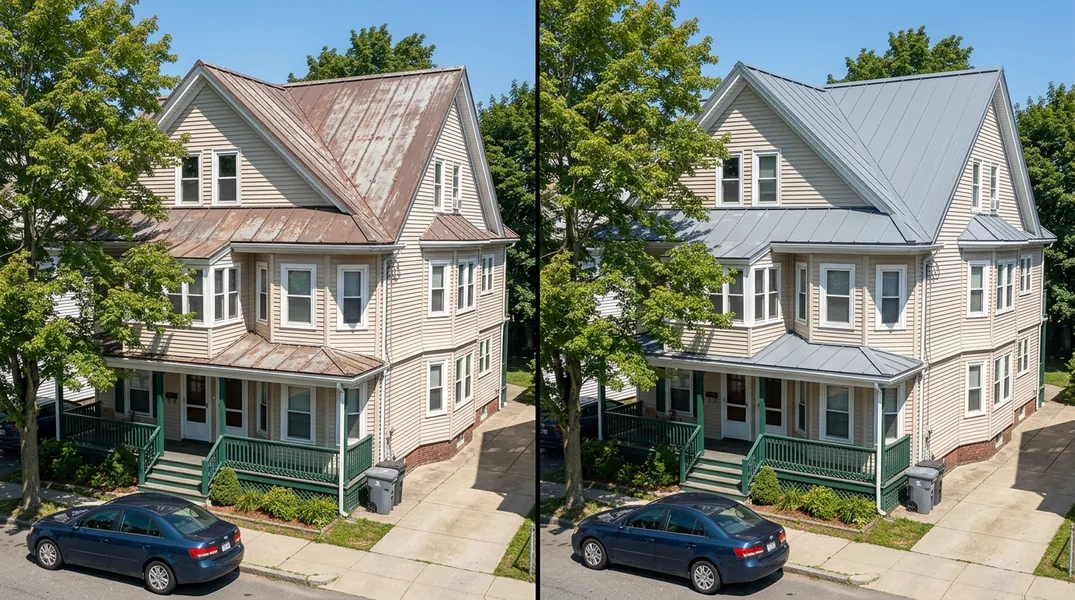
Why New England Winters Are Hard on Any Roof
If you own a home in Boston, you already know the routine: nor'easters dump a foot of snow, temperatures swing from 35°F to 5°F overnight, and the freeze-thaw cycle repeats for months. That combination is brutal on roofing materials. Asphalt shingles become brittle in the cold, and repeated expansion and contraction can loosen fasteners and open seams. Ice dams form at the eaves when warm attic air melts snow on the upper roof, and that water refreezes before it can drain. The result is water backing up under shingles and into ceilings, insulation, and drywall.
Metal roofing performs differently in this climate because of how it sheds snow and handles thermal movement. A smooth, low-friction surface lets snow slide off once it accumulates past a certain depth, especially on steeper pitches common on older Cambridge and Somerville homes. Standing seam panels are attached with concealed clips that allow the metal to expand and contract without stressing seams or fasteners. That matters in a region where a single roof might see dozens of freeze-thaw cycles between December and March.
How Metal Roofs Handle Snow Loads and Ice Dams
The phrase "metal roof snow" often brings up two questions: will it hold the weight, and will it shed safely? Modern metal panels are engineered to meet local snow load requirements, which in Massachusetts are among the higher in the country. The structural capacity comes from the panel profile, the purlin spacing, and how the system is attached to your deck or rafters. A properly specified Standing Seam Metal Roofing system is more than capable of carrying typical Boston-area snow loads, and it does so without the granule loss and mat cracking that plague aging shingles.
Ice dams are the bigger concern for most homeowners, and this is where metal shines. Because metal absorbs and releases heat differently than asphalt, and because the surface is slick, snow tends to release in sheets rather than melt slowly into the eaves. That reduces the volume of meltwater that can refreeze at the edge. That said, metal is not a magic bullet: ice dams are fundamentally an insulation and ventilation problem. If warm air is leaking into your attic, you can still get ice at the gutters even with a metal roof. The best defense is a well-sealed building envelope paired with the right underlayment and, where needed, ice-and-water shield at the eaves.
The Freeze-Thaw Cycle and Why It Matters for Massachusetts Roofing
Massachusetts roofing contractors see the same pattern every spring: hairline cracks, popped fasteners, and water stains that appeared after a winter of constant thawing and refreezing. Water is relentless. It works into tiny gaps, freezes, expands, and widens those gaps a little more each time. Materials that can't flex with that movement eventually fail. Metal roofing handles freeze-thaw well because the panels move as a unit, guided by clips and fasteners designed for thermal expansion. There are no granules to wash away and no asphalt to crack.
It's also worth thinking about what happens at the roof edge. Snow sliding off a metal roof can pile up against doors, walkways, and landscaping. Homeowners in Brookline and similar neighborhoods often add snow guards above entryways and driveways to break up the slide into smaller pieces. This is a small detail that makes a big difference in daily life during a Boston winter, and it's one of the things a good installer will discuss with you during the design phase.
Insulation and Ventilation: The Hidden Half of Winter Performance
Here's the part many homeowners miss: the roof is only half the system. Metal roof insulation and attic ventilation determine whether your roof stays cold on the underside during winter. If warm air escapes from your living space into the attic, it heats the roof deck, melts snow from below, and sets up ice dams regardless of what's on top. Before any Metal Roof Installation, we look at attic insulation levels, air sealing around penetrations, and ventilation paths at the soffit and ridge. Getting those right protects both your investment and your comfort.
Metal roofs also pair well with above-deck insulation options, which can improve energy performance and reduce thermal bridging. In older Boston homes with limited attic space, that flexibility is a real advantage. The goal is a roof assembly that stays cold on the outside, vents moisture on the inside, and doesn't rely on heat loss to keep snow moving. When that balance is right, a metal roof becomes genuinely low-maintenance through the worst of a New England winter.
Metal Roof Replacement Near Me: When to Call a Pro in Boston
If your current roof is 15 to 25 years old, you're seeing ice dams every winter, or you've noticed granule loss and curling shingles, it may be time to consider a Metal Roof Replacement. Metal is a long-term decision, and the details matter: panel gauge, seam height, clip spacing, underlayment, and flashing at chimneys and skylights. A local installer who understands Boston's older housing stock and its snow load requirements will specify a system that performs, not just one that looks good on day one.
Some homeowners ask about a Metal Roof Over Shingles (Retrofit), which can save on tear-off costs when the existing roof deck is sound. It's a legitimate option in many cases, but it isn't right for every home, and it requires careful evaluation of the deck and local code. If you're weighing options, it helps to talk through pricing and scope with a professional before committing. Boston Metal Roofing offers a free estimate, and you can reach us at (857) 465-5405 to schedule a roof assessment. A metal roof is a big investment, but when it's designed for New England winters, it can be the last roof your home needs for decades.
Looking for a professional metal roofing contractor in Boston? Boston Metal Roofing responds fast for all your metal roofing needs.
Get a Free QuoteOur services: Metal Roof Installation · Standing Seam Metal Roofing · Metal Roof Replacement